PDN Annual report 2025

Back to report

Welcome

Welcome to the annual report 2025

We have brought 2025 into focus for you. In this annual report, we show the most important developments and figures at Pensioenfonds PDN and list the main points. What has the fund done with your pension money? How did the funding ratio develop and what about the investment results?

Click at the bottom of this page for a print version (PDF) of this annual review for 2025. More information about the year 2025 at Pensioenfonds PDN can be read in the full annual report, which can be found on the website of Pensioenfonds PDN under Downloads.

Key figures

The year 2025 in key figures

2025 in key figures: an overview of participants, assets, contributions, returns, funding ratios and indexation.

Participants

Total

202426,646 persons
202526,345 persons

-1.1% decline

Active

20245,629 persons
20255,563 persons

-1.2% decline

Deferred participants

20248,382 persons
20258,147 persons

-2.8% decline

Pensioners

202412,635 persons
202512,635 persons

+0% growth

Financial key figures

Pension liabilities

20246.38 million euro
20255.7 million euro

-10.7% decline

Pension liabilities are the pensions that Pensioenfonds PDN must pay out now and in the future.

Pension assets

20247.81 million euro
20257.75 million euro

-0.8% decline

Pension assets are the assets of Pensioenfonds PDN: Investments + other receivables - other liabilities

Contributions received

2024111 million euro
2025115 million euro

+3.6% growth

Contributions received are the contributions that employer and employee pay for pension accrual.

Pension payments

2024273 million euro
2025279 million euro

+2.2% growth

Pension benefit payments are the payments for pensions already in payment.

Total invested assets

20247.8 million euro
20257.74 million euro

-0.8% decline

Total invested assets is the total value of the investment portfolios.

Investment return

Investment return

2025+1.6%

Investment return consists of direct and indirect investment proceeds. This can be interest (on bonds), dividends (on equities), or the increase or decrease in the market value of a pension fund's assets.

Funding ratios

Funding ratio

Start 2025122.3%
Eind 2025135.9%

+13.6% growth

The funding ratio is a measure of the financial position of Pensioenfonds PDN, expressed as a percentage. This percentage represents the ratio between the fund's assets and all financial obligations, now and in the future. The higher the funding ratio, the more certain it is that Pensioenfonds PDN will be able to pay out the promised pensions.

Policy funding ratio

Start 2025124.9%
Eind 2025130.3%

+5.4% growth

The policy funding ratio is the average funding ratio over the past 12 months.

Required funding ratio

Start 2025116.4%
Eind 2025116.8%

+0.4% growth

The required funding ratio indicates how high the fund's policy funding ratio legally must be. If the policy funding ratio falls below the required funding ratio, Pensioenfonds PDN must submit a recovery plan.

Minimum required funding ratio

Start 2025104.2%
Eind 2025104.2%

+0% growth

The minimum required funding ratio indicates the absolute lower limit. If the fund's policy funding ratio falls below this, there is a funding deficit. Pensioenfonds PDN then has too little assets to be able to pay out pensions in the future. If the policy funding ratio remains below the minimum required funding ratio for 5 years, the fund must reduce (cut) the (accrued) pensions.

Indexation

Indexation for pensioners and deferred participants

20241.78%
20253.01%

Pension Fund PDN aims to increase pensions every year and to let them grow in line with price increases. This is called indexation or granting of supplements.

Indexation for active participants

20241.78%
20253.01%

Pension Fund PDN aims to increase pensions every year and to let them grow in line with price increases. This is called indexation or granting of supplements.

Finances

The financial position of Pensioenfonds PDN

The funding ratio is an important measure of the financial situation of the pension fund. The funding ratio indicates the extent to which the pension assets at a given time are sufficient to meet all future pension obligations (in particular the pension payments). In addition to the funding ratio, a pension fund must also calculate a so-called 'policy funding ratio'. This policy funding ratio is the average of the last twelve monthly funding ratios. Based on the level of the policy funding ratio, it is determined whether a pension fund must reduce the accrued pensions and pensions in payment.

Funding ratio

Start 2025122.3%
Eind 2025135.9%

+13.6% growth

The funding ratio is a measure of the financial position of Pensioenfonds PDN, expressed as a percentage. This percentage represents the ratio between the fund's assets and all financial obligations, now and in the future. The higher the funding ratio, the more certain it is that Pensioenfonds PDN will be able to pay out the promised pensions.

Policy funding ratio

Start 2025124.9%
Eind 2025130.3%

+5.4% growth

The policy funding ratio is the average funding ratio over the past 12 months.

We are happy to explain to you how the 2025 funding ratio is calculated.

Download funding ratio calculation pdf

Download funding ratio calculation pdf

At the end of 2025, the funding ratio was 135,9%, which is 13,6% higher than the funding ratio at the beginning of the year (122,3%). In addition to the funding ratio, a pension fund must also calculate a so-called 'policy funding ratio'. This policy funding ratio is the average of the last twelve monthly funding ratios. At the end of 2025, the policy funding ratio was 130,3%, which is 5,4% higher than at the beginning of the year (124,9%).

Based on the level of this policy funding ratio, it is determined whether a pension fund is in a deficit situation and must submit a recovery plan to de Nederlandsche Bank. In a recovery plan, a fund indicates how it intends to achieve a higher funding ratio in the coming years. The policy funding ratio determines whether or not pensions are increased (indexation).

Pension increase

Full increase133%
Partial increase130.3%
No increase and increased chance of reduction110%

Based on the financial situation of the fund as of the end of October 2025 and the expanded statutory pension increase options for funds planning to transition, the board assessed in 2025 whether to grant pension increases as of December 31, 2025. The fund decided that all (former) participants and pensioners would receive a pension increase of 3.01% (equal to the full measure for price inflation). This concerns an additional pension increase of 0.68% compared to what would have been granted if the regular pension increase policy of Pensioenfonds PDN had been applied.

Pensioenfonds PDN tries to let the pension of pensioners and former participants grow each year with the increase in prices, and to let the pension of active participants increase with the increase in wages. This is the ambition of Pensioenfonds PDN and this is called granting a pension increase or indexation. This is only possible if the financial situation of the pension fund is good enough.\n\nMore information about granting pension increases can be found on the website of Pensioenfonds PDN.

Due to the full granting of pension increases, there are no missed pension increases for 2025. The missed pension increases (from previous years) are tracked in accordance with the catch-up pension increase policy of Pensioenfonds PDN, so they can potentially be caught up if the financial position of the fund allows it.

More information about granting pension increases can be found on the website of Pensioenfonds PDN.

Indexation for pensioners and deferred participants

20241.78%
20253.01%

Pension Fund PDN aims to increase pensions every year and to let them grow in line with price increases. This is called indexation or granting of supplements.

Indexation for active participants

20241.78%
20253.01%

Pension Fund PDN aims to increase pensions every year and to let them grow in line with price increases. This is called indexation or granting of supplements.

Investments

How we invest the money

To be able to pay out pensions every month, pension premiums alone are not enough. A pension fund must invest. By investing, we make a profit. That is the return. In the long term, investments yield a higher return than a savings account. The return indicates what the investment has yielded and is expressed as a percentage.

Investment portfolio

2025
2024
Total invested assets (in € mln)
7,735
7,342

Total invested assets are shown in millions of euros. The total amount for 2025 is compared with 2024.

Categorymln. euro (2025)WeightStrategic weight
Matching portfolio3,810 mln. euro49.2%49.5%
Interest overlay-149 mln. euro-3.9%—
Nominal government bonds1,312 mln. euro34.4%32.5%
Inflation-linked bonds929 mln. euro24.4%23.3%
Investment grade credits676 mln. euro17.8%16.9%
Mortgages982 mln. euro25.8%25.8%
Ground lease60 mln. euro1.6%-0.4%
Return portfolio3,853 mln. euro49.8%50.5%
Currency overlay8 mln. euro0.2%—
Equities1,693 mln. euro43.9%43.9%
High-yield bonds761 mln. euro19.7%19.8%
Listed real estate316 mln. euro8.2%8.3%
Alternative investments1,075 mln. euro27.9%27.9%
Cash58 mln. euro0.8%0%
PPS14 mln. euro0.2%—
Total7,735 mln. euro100%100%
Pensioenfonds PDN has split its investments into a matching and a return portfolio.

Matching portfolio

The objective of the matching portfolio is to achieve a favorable risk/return profile with high-credit-quality bonds. This aims for a high degree of certainty. With this, we hedge part of the interest rate risk.

Return portfolio

The objective of the return portfolio is to achieve sufficient return to realize the indexation ambition. Through an active policy, an attempt is made within the permitted risk budget to achieve extra return after costs or to realize a lower risk profile.

To reduce risk, Pensioenfonds PDN spreads its investments across various categories. These include, for example:

Inflation-linked bonds▾

These are loans to (mainly) governments, where the interest and principal repayments are linked to inflation. This means that you are compensated for realized inflation and that a real return is thereby secured.

Investment grade credits▾

These are loans to companies with good creditworthiness. The term of these loans is generally relatively short (4-5 years). Due to the good creditworthiness, the probability that the loans including interest will be repaid is very high and the risk is low.

Bonds and loans (fixed-income securities)▾

This involves lending money worldwide to governments and companies. The return (the so-called interest payment) is generally stable. In addition, Pensioenfonds PDN also invests in Dutch private mortgages.

Equities▾

This involves taking a global stake in the capital of a company. In the longer term, a higher return can be expected than on bonds, but the risk is relatively high.

Alternative investments▾

This is an investment category from which an attractive return is expected in the medium term. The investments within this sub-portfolio therefore aim for an attractive return without being dependent on benchmarks (market indices, such as the AEX). This includes, for example, investments in microfinance, infrastructure, and commodities.

Real estate▾

There are two ways to invest in real estate: directly (houses, shops and offices) and indirectly (shares in real estate funds). Pensioenfonds PDN invests worldwide only in indirect real estate.

Currency overlay▾

Investments are made in various currencies. Because the currencies can rise or fall in value relative to the euro, the return of the internationally diversified portfolio consists partly of currency returns. To limit the impact of currencies on the fund's return in euros, a currency overlay is used. In doing so, the fund hedges itself against currency movements.

Interest rate overlay▾

The interest rate sensitivity of the pension liabilities differs from that of the investments. As a result, interest rate risk is incurred. To limit this risk, a portion of the interest rate risk is hedged with fixed-income securities and derivatives. The interest rate overlay partly determines a portion of the fund's return.

Investment return (%)

Category2025Benchmark (%)
Total portfolio1.6%1.1%
Matching portfolio-8.8%-9.3%
Return portfolio13.4%12.9%

You do not need to be alarmed by a negative return. Pensioenfonds PDN invests with a long-term horizon. Fluctuations are expected to be compensated over the years.\n\nAt the end of 2025, the 5-year average net return is 2.3% on an annual basis.\nThe 10-year average net return of Pensioenfonds PDN at the end of 2025 is 3.9% on an annual basis.

Transaction costs

Transaction costs are costs that must be incurred to execute purchases and sales and to process them administratively.

20240.07%
20250.06%

Decrease/growth

-0.01%

Asset management costs

Asset management costs are costs for managing the investments, expressed as a percentage of the average invested assets.

20240.42%
20250.39%

Decrease/growth

-0.03%

Communication

Pensioenfonds PDN uses various channels to communicate with its participants

Some means of communication in figures

www.pdnpensioen.nl

63,144Visits
173Average visits per day

Digital newsletter

4,058Subscribers
4Sent

My PDN pension

68,494Visits
188Average visits per day
68.6%Post-Digital users

E-cards for 40-year-olds

128Total e-cards sent

Targeted mailing

10Sent

PDN Magazine

20,000Circulation
  • EditionMay
  • EditionOctober

Appreciation

NL Planner

7.7

Rating

My PDN pension

7.6

Rating

Pension Journey

Pension journey entering service

660Sent
294Visits

Personal conversations

162Count

Questions which can and have to be answered within three business days.

First-line questions

1,393Total
98.6%Timely
8Rating

More complex questions which have to be answered within ten business days.

Second-line questions

672Total
94.2%Timely
8Rating

Appreciation

Retirement pension grant

8.0

Rating

Partner pension grant

8.9

Rating

Value transfer

8.4

Rating

Appreciation of personal conversations

9.4

Rating

Conversations 162

Accountability council

What's the opinion of the Accountability Council?

The Accountability Council (AC) is tasked with giving an opinion on the policy pursued by the board in 2025 and the policy choices for the future. In doing so, the AC continuously assesses whether the interests of the various stakeholders have been balanced equitably. The AC consists of eight members drawn from the ranks of pensioners (4), participants (2), and employer (2).Under the Future of Pensions Act (Wtp), the AC has been granted enhanced advisory rights because participants have not been granted an individual right of objection.

The accountability council

Ton de Boer

Ton de Boer

(Chairman) Elected from and by pensioners

Audrey Ringens

Audrey Ringens

(Deputy chairman) Appointed by employer

Alexander van den Heuvel

Alexander van den Heuvel

Appointed by employer

Albert Noteborn

Albert Noteborn

Elected from and by pensioners

Feike Hylarides

Feike Hylarides

Elected from and by pensioners

Jan Schreuder

Jan Schreuder

Elected from and by employees

Marc Silvertand

Marc Silvertand

Elected from and by employees

Marjon Doggen-Muijres

Marjon Doggen-Muijres

Elected from and by pensioners

SUMMARY OPINION FOR 2025

The AC is positive about the cooperation with the Board and other fund bodies in 2025. The AC compliments the Board on having the core task of the fund - administering the pension scheme - well in order during a challenging year in which a lot of extra work had to be carried out for the Wtp transition. In addition, the AC considers that the Board has sufficiently ensured the balanced nature of decisions in the Wtp transition dossier. In communication to participants, the AC requests, on the one hand, special attention to the quantitative aspects of the financial consequences of the decisions taken and, on the other hand, a transparent explanation of the change in risks. The AC considers these important for the confidence of participants and to enable a balanced and transparent transition.


FOLLOW-UP RECOMMENDATIONS FOR 2024 (in 2025)

In the annual opinion for 2024, the AC identified 5 priority areas for 2025:

1. Progress of the Wtp transition process.

2. Communication within the context of the Wtp to (former) participants and pension beneficiaries.

3. The establishment of a future vision for Pensioenfonds PDN after the Wtp transition.

4. Monitoring of general administration costs and Wtp project costs.

5. Policy regarding indexation until the transition date.

These priority areas return in this annual opinion with the following recommendations:


Re 1. Recommendation

  • Expeditiously complete open recommendations and inform the AC periodically about the progress.


Re 2. Recommendation

Pensioenfonds PDN's communication in 2025 was largely dedicated to the Wtp. The Board involved the AC in a timely manner in the new communication plan and the associated campaign.

  • Continue to communicate clearly, especially about the risks and consequences of the Wtp for individual participants. Ensure that the website remains accessible and up to date in 2026 as well.


Re 3. Recommendation

  • In 2026, give priority to completing the strategic reorientation, including a clear project plan with milestones and keeping an eye on innovation. Only adjust governance once the strategy has been established.


Re 4. Recommendation

  • A multi-year estimate for pension administration costs after the introduction of the Wtp, including clear objectives and a transparent comparison with external benchmark rates. In doing so, monitor the financial outcomes of the fee arrangements agreed in advance for both Pensioenfonds PDN and DPS.


Re 5. Recommendation

The AC is pleased that the maximum pension increase (indexation) for 2025 could be granted. Due to postponement of the transition date to 1 January 2027, the indexation policy will also apply in 2026. The AC expects to be involved in this in a timely manner.


RECOMMENDATIONS 2025

In this reporting year, the AC assessed (positively) 2 formal requests for advice on the intended transition decision and on the extension of the administration agreement. In addition, the AC provided input on the Wtp communication plan and the AC received various responses from the board to written question rounds from the AC to the board regarding the transition file.


In its advice on the transition decision, the AC gave the board nine recommendations. These focused more on:

  • establishing the maximum acceptable relative difference in progress between participant cohorts;
  • re-assessing the risk appetite of participants within one year after transition; and
  • special attention to maintaining purchasing power both before and after the moment of transition.

The AC also advised including a hardship clause in case a group of participants turns out to require additional attention or additional measures.


Based on its findings, the AC makes the following additional recommendations:

Governance

  • The AC advises recalibrating PDN's governance as soon as the new strategy and the setup of the fund after the transition are clear. In doing so, the AC emphasizes that PDN must remain well aligned with the strategic plans of DPS so that the visions do not interfere with each other.
  • In addition, the AC considers it important that Pensioenfonds PDN makes a multi-year agreement in advance with DPS regarding, among other things, the annual allocation of results, the dividend policy, and the desired level of DPS's reserves, as also mentioned in the 2024 annual report.

Extension of administration agreement

  • Communicate intended decisions in a timely manner and involve the AC early in the process, particularly where the AC has advisory rights.


KEY PRIORITIES 2026

The AC identifies four priorities for 2026:

  1. A careful transition to the new system as of 1 January 2027, with clear communication on the consequences for participants;
  2. The progress of the strategy project of Pensioenfonds PDN and DPS;
  3. The multi-year estimate of the implementation costs of Pensioenfonds PDN after the Wtp transition;
  4. A timely and well-considered decision on the granting of indexation for 2026.


The complete text and the opinions of the accountability body can be read in the full 2025 annual report of Pensioenfonds PDN and on the website in the 'News from the AC' section.

Supervisory Board

The conclusion of the Supervisory Board

The Supervisory Board supervises the board of Pensioenfonds PDN and assesses the functioning of the board and the processes used by the board. The Supervisory Board consists of three members.

Composition

Marlies van Loon

Marlies van Loon

Rajesh Grobbe

Rajesh Grobbe

Cor van der Sluis

Cor van der Sluis

(Chairman)

The task of the council is determined by the legal framework and the articles of association and the regulations of the fund. The council oversees adequate risk management and balanced consideration of interests by the board and assists the board with advice.

The board operates in a complex environment, which requires a major effort to manage the strategic, policy agenda of the board. After all, in addition to implementing the Wtp, vision, strategy and governance are elements that affect the future position of the fund and, in the opinion of the council, are highly interrelated. The board ensured that there was continuity of management in the absence of the chairman and kept the council well informed about this.


SUPERVISION (THEMES) 2025

The council uses the Pension Funds Code as a starting point for its supervision. In addition to the aforementioned statutory minimum tasks, the council will in any case focus on the following spearheads in 2025:

Future of Pensions Act (Wtp)

  • How does the board prepare the fund for a controlled and ethical transition to the new pension system?
  • How does the board ensure that the Wtp communication is complete, timely, correct and balanced for all pensioners and entitlement holders?

Digital Operational Resilience Act (DORA)

  • How does the board ensure that the fund complies with the new DORA requirements for digital resilience?

Cost control

  • How does the board ensure efficient, effective and transparent cost management?

Strategy post Wtp

  • How does the board shape a future-oriented strategy for the fund after the Wtp implementation?


RECOMMENDATIONS

Based on findings in the calendar year 2025, the council makes the following recommendations for 2026:

  • Establish one integral steering framework for the Wtp transition and the implementation at DPS with clear milestones, go/no-go moments, escalation points and fallback scenarios.
  • Strengthen control over the outsourcing chain by periodically reporting on progress, risks, dependencies and the 'assurance' required to determine that the execution is ready for the transition in a timely and controlled manner.
  • Establish a coherent communication approach in 2026 for both the remaining Wtp transition and the period thereafter, and safeguard testing for clarity, balance, comprehensibility and effectiveness within it.
  • Strengthen the strategy process with sufficient capacity and expertise, finalize the post-Wtp fund strategy in 2026 and translate this into a recalibrated governance model, appropriate staffing (with attention to the diversity of the composition of the fund bodies) and a concrete implementation agenda.
  • Ensure that signals, advice and opinions from the Supervisory Board, key function holders and other fund bodies are discussed by the board in a timely manner, explicitly weighed and demonstrably followed up.
  • Strengthen the future agility of the fund by continuing to invest in digital resilience, AI framework setting, expertise, countervailing power and diversity in the composition of the board and other fund bodies.


KEY PRIORITIES 2026

In addition to its statutory minimum tasks, the Supervisory Board will focus on the following key priorities in 2026:

Future of Pensions Act (Wtp)

  • Timely, correct, complete and balanced Wtp communication
  • Timely, controlled & sound transition of the pension systems for the implementation of the SPR scheme (grip on the outsourcing chain)
  • Project-based follow-up approach for coordination with DNB, social partners and fund bodies
  • Implementation of investment strategy

Communication

  • post-Wtp communication strategy
  • Further development of participant-oriented choice guidance

IT/Cybersecurity

  • IT risk management and operational resilience
  • Grip on outsourcing chains and assurance of suppliers

Cost control

  • Efficient, effective and transparent cost management as a board policy instrument

Post-Wtp strategy

  • Align post-Wtp fund strategy with stakeholders
  • Recalibrate governance model (including staffing)
  • Operationalize fund strategy with a clear 'Plan-Do-Check-Act' cycle


The full text of the findings and recommendations of the Supervisory Board and the response of the board of Pensioenfonds PDN to them can be found in the full annual report.

Board

Members of the Board

The Board of Pensioenfonds PDN consists of eight members, supplemented by an independent chairman. Four members are appointed upon nomination by employers, two members are appointed upon nomination by the Central Works Council of DSM Nederland BV and two members are appointed from and by pensioners.

The Board thanks the Supervisory Board and the Accountability Council for sharing their findings and recommendations. The recommendations help enable the Board to carry out its duties carefully, in a balanced manner, and in the interests of the (former) participants, pensioners, other beneficiaries, and the employer(s). The Board is very grateful to the RvT and the VO for their dedication in 2025, their commitment, and the constructive discussions. The Board looks forward with confidence to continuing the open and close cooperation. The complete response of the Board to the opinions of the Accountability Council and the Supervisory Board, as well as the text of those opinions, can be read in the full 2025 annual report of Pensioenfonds PDN.

Board composition

Arend de Jong

Arend de Jong

Independent Chairman

Ivo Nelissen

Ivo Nelissen

Board member - Appointed upon nomination by the employers

Laurine Lemon

Laurine Lemon

Board member - Appointed upon nomination by employers

Piet Molenaar

Piet Molenaar

External board member - Appointed upon nomination by employers

Peter Pasmans

Peter Pasmans

Board member - Appointed upon nomination by employers

Eiko de Vries

Eiko de Vries

External board member - Appointed upon nomination by the central works council of DSM Nederland BV

Wim Reinartz

Wim Reinartz

Board member - Appointed on the recommendation of the central works council of DSM Nederland BV

Piet Rennen

Piet Rennen

Board member - Elected from and by pensioners

Arie Sonneveld

Arie Sonneveld

Board member - Elected from and by pensioners

Sustainability

The sustainability policy

Pension Fund PDN explains its sustainability policy and accounts for the main results for the reporting year 2025 in the Sustainability Report 2025. The full sustainability report can be found on the website of Pension Fund PDN under downloads.

In light of the pursuit of sustainability and responsible investment, the fund further tightened its sustainability policy in 2025. To be able to assess and manage the most material sustainability risks, Pensioenfonds PDN further developed the ESG risk framework in 2025 and set up an ESG risk dashboard. In 2026, it will be assessed whether additional relevant risk factors must be included. The fund also further refined the escalation policy regarding the progress of engagement trajectories and acted upon this in 2025. The focus has shifted from responsiveness to actual progress made. In addition, Pensioenfonds PDN evaluated the sustainability indicators and concluded that the KPI on achieving engagement‑milestones was steerable and therefore did not make the desired impact. This KPI was therefore scrapped, while the SDG‑oriented KPI is retained. Pensioenfonds PDN will continue to evaluate the KPIs and tighten them where necessary.

The fund reports transparently on the implementation and effects of the sustainability policy in this sustainability report, which is also published on the fund's website. However, as of 2025, the figures are no longer externally audited for cost reasons.

With a view to a sustainable future, we will continue our efforts in 2026, and we remain committed to promoting sustainability in every layer of investment policy.

Future perspectives

Looking ahead, we see several important themes that deserve attention:

  • Digital transformation and sustainability: The role of technology in promoting sustainability is significant. Innovations can contribute to energy efficiency and the development of smart, sustainable cities.

  • Social inclusion and employment: By investing in sustainable projects, we can contribute to job creation and the promotion of social inclusion.

  • Circular economy: Supporting companies that embrace the principles of the circular economy is a step towards minimizing waste and using resources efficiently, including water management.

  • Ethical investing and human rights: It is our responsibility to ensure that investments embrace ethical considerations and respect for human rights.

  • Biodiversity: Protecting and promoting biodiversity is essential for the preservation of healthy ecosystems, which are crucial for life on earth. More and more attention is being paid within the investment world to investments that contribute to the protection of natural habitats and the diversity of species.

We see the complexity of the challenges we face and at the same time we see the opportunities to make a positive impact. With dedication, innovation, and collaboration, we can contribute to a more sustainable and fairer world for everyone. To increase our positive influence as a fund, we have been focusing on three specific sustainability themes since 2021:

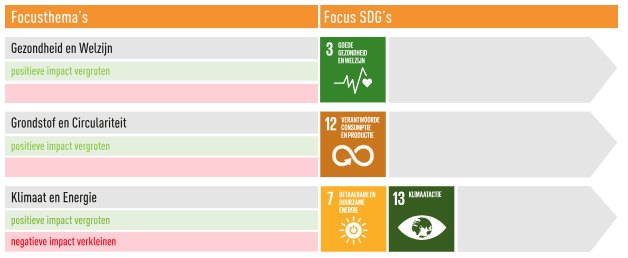
  1. Health and well-being

  2. Climate and energy

  3. Raw materials and circularity.

These themes are linked to four sustainable goals of the United Nations, the Sustainable Development Goals (SDGs). We specifically look at:

  • SDG 3: Good health and well-being

  • SDG 7: Affordable and sustainable energy

  • SDG 12: Responsible consumption and production

  • SDG 13: Climate action

media&token=b5c9c30b-867d-4b00-af9e-5900e3539918

Six policy instruments have been defined in the sustainability policy, which are used to contribute to objectives.

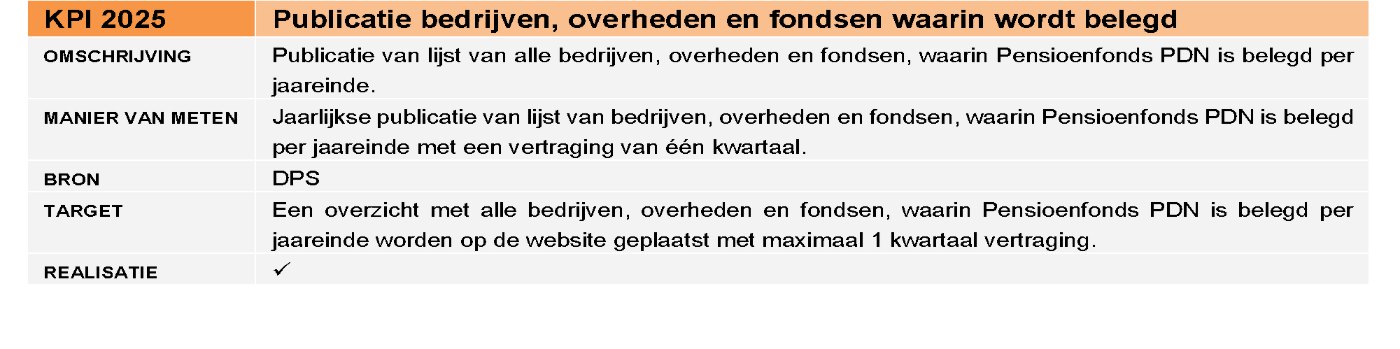
More information about the sustainability policy and the policy instruments that Pensioenfonds PDN uses within it can be found on the fund's website via this link. On this page, an explanation of the policy pursued can also be found, including reports on how votes were cast during shareholder meetings and the progress of engagement actions. The fund also publishes the list of companies and countries in which it has invested (as of year-end) on the website.

1. ESG integration

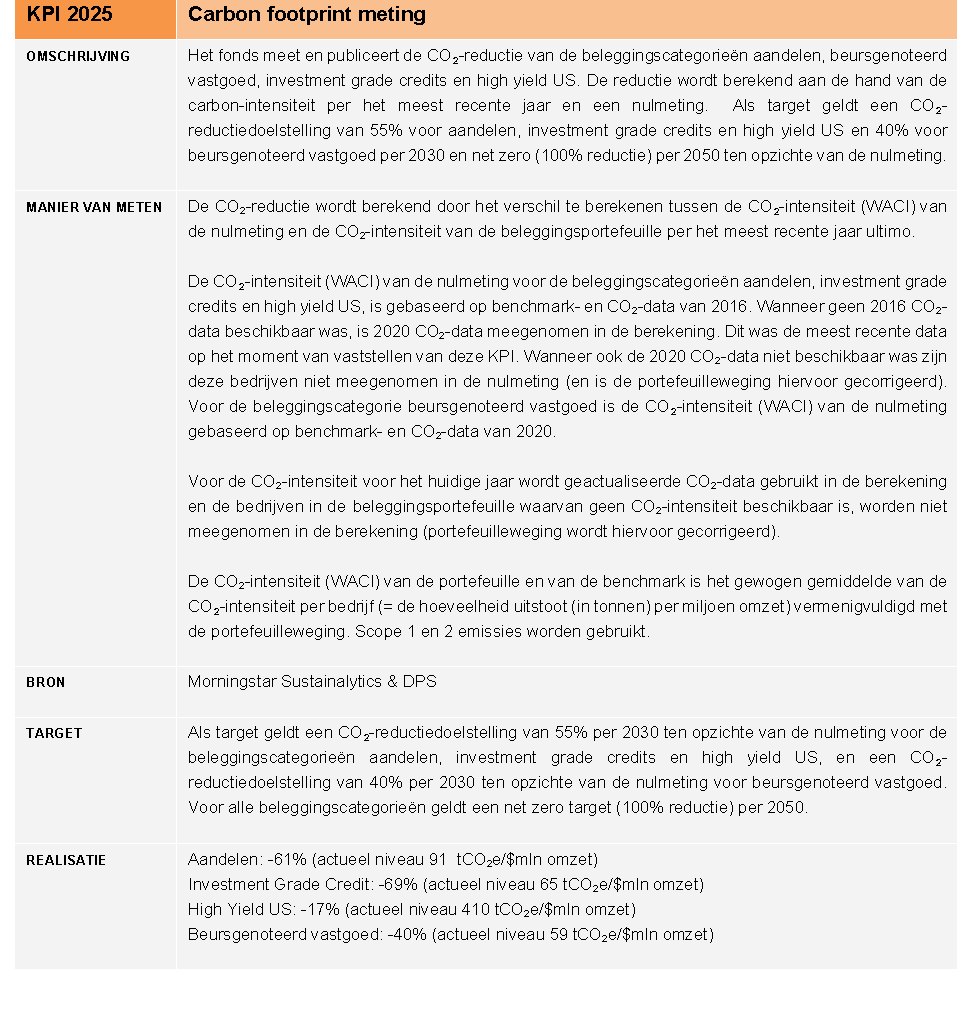
Pensioenfonds PDN utilizes ESG factors wherever possible in the management and assessment of investments. ESG stands for Environment (environment), Social (social), and Governance (corporate governance). Sustainability risks for the portfolio and other ESG aspects are taken into account in investment decisions in the various mandates. Another striking aspect that falls under this is CO2 emissions. With ESG integration in the investment process, Pensioenfonds PDN tries to reduce the CO2 emissions of the investment portfolio. Whether or not this objective is actually achieved can only be determined after 2030. However, we can monitor the progress of the CO2 reduction in the meantime.


Realization of CO2 reduction objective
media&token=972914de-c453-439b-9d0d-2036a80ebd59


2. Impact Investments

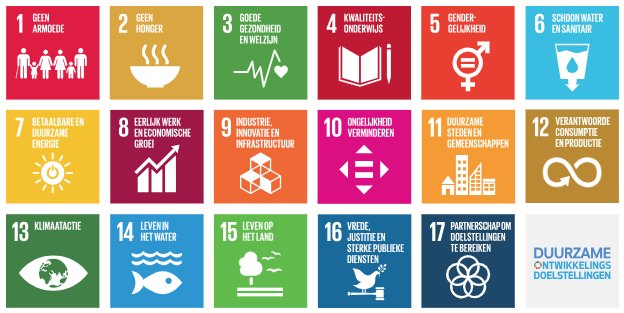
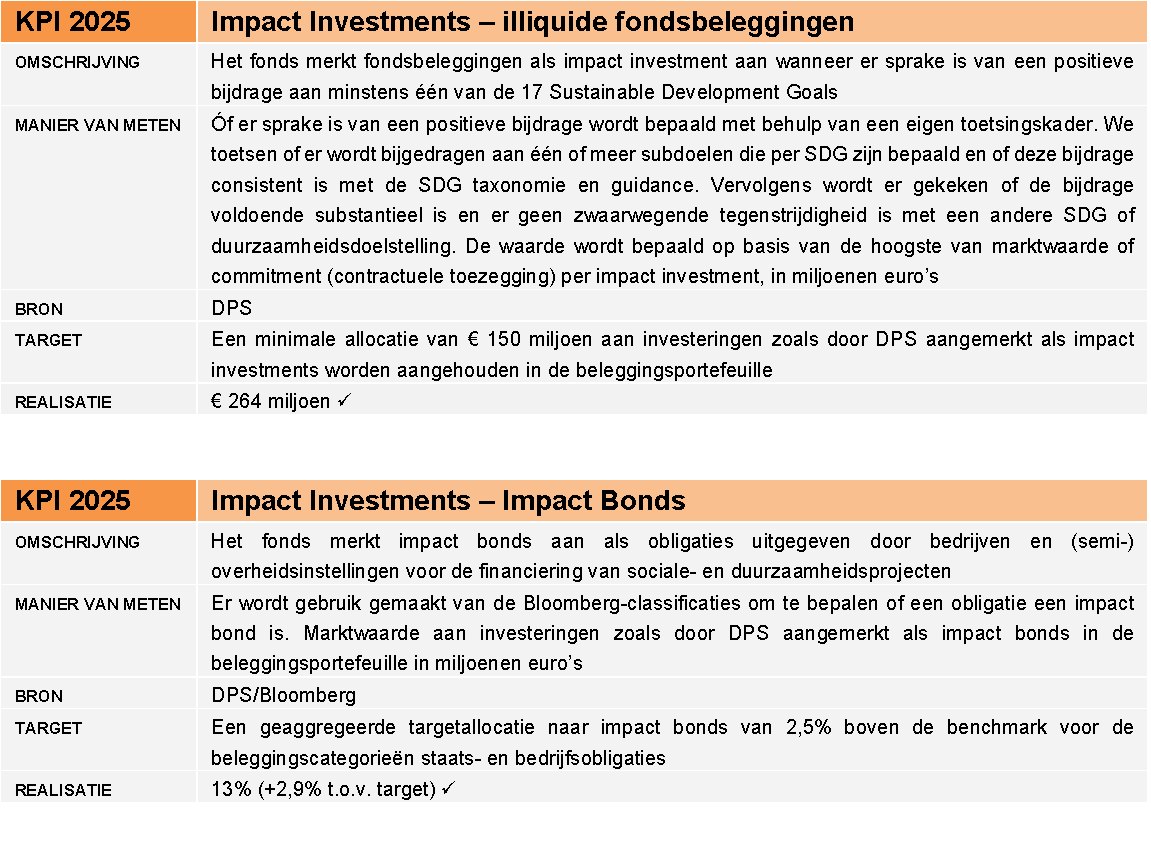
Impact investments are investments in countries, companies, or projects that also help solve social and environmental problems, such as poverty and climate change. Pensioenfonds PDN does this based on the Sustainable Development Goals of the United Nations.

media&token=08ce9c35-c0c4-4644-966c-afd75af210ba

Realization of Impact Investments objective
media&token=e72f928a-7fcf-4aaf-b41f-90f10e15602e3. Engagement

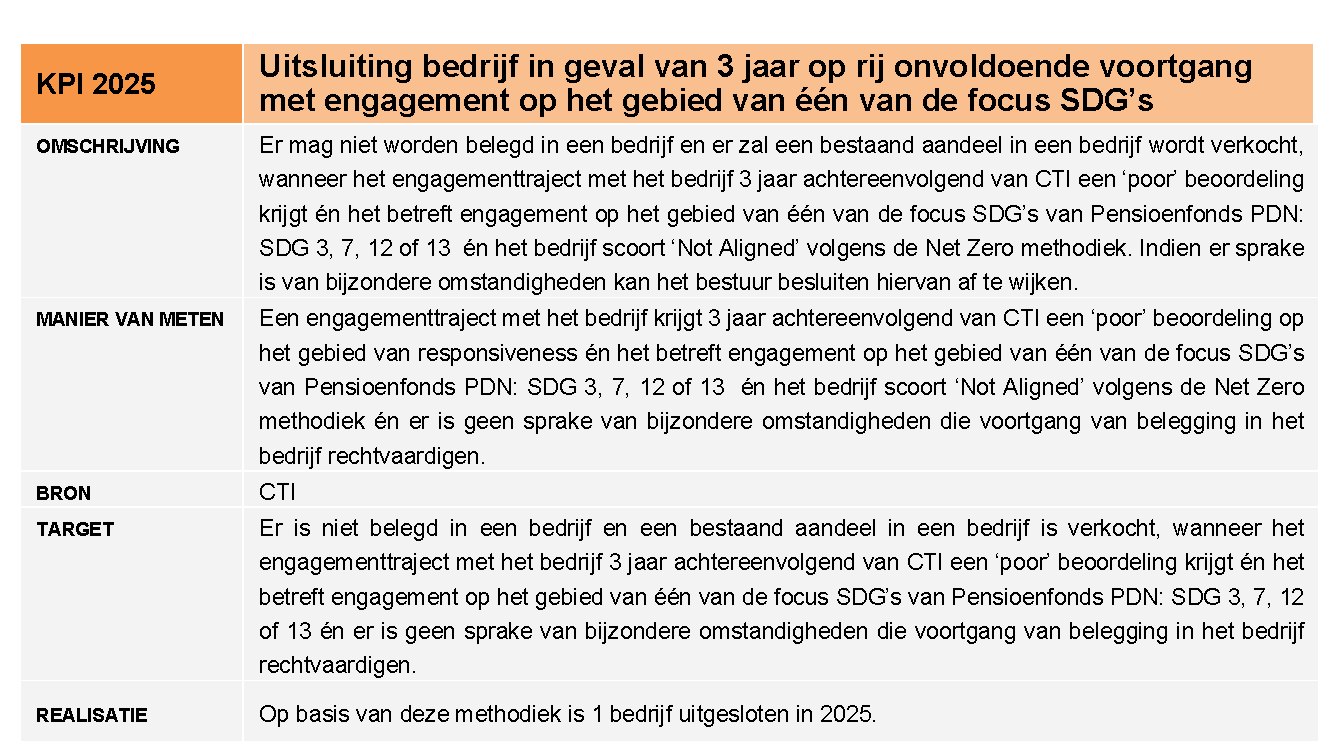
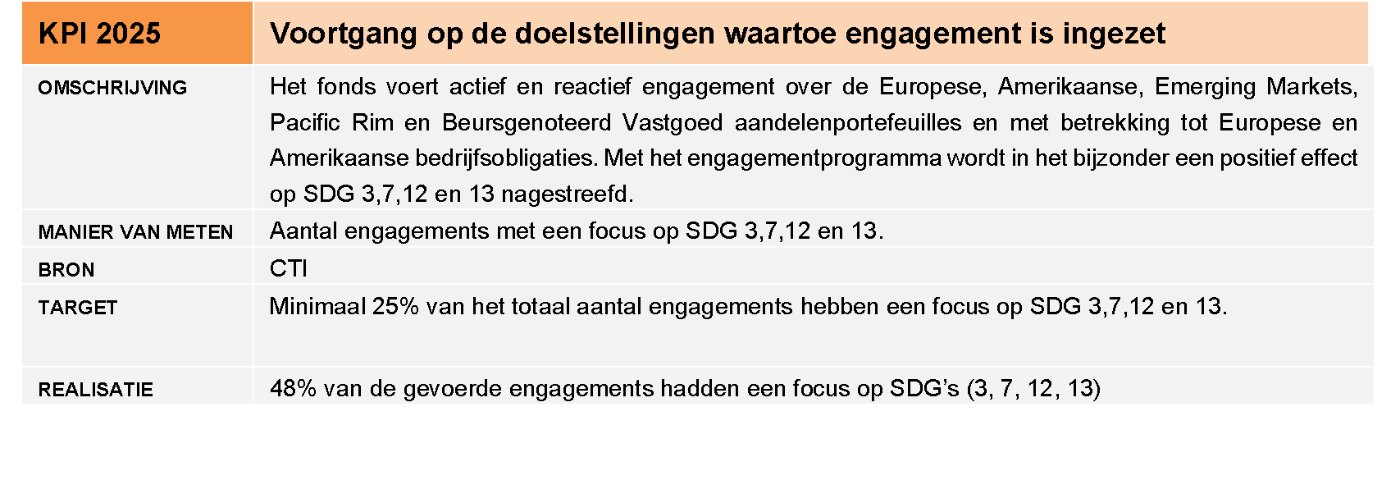
With engagement, a dialogue is entered into with companies in which investments are made. In this way, stakeholders can encourage companies to change. Through the instrument of engagement, it is possible to make agreements with companies about plans, goals, or ambitions. For example, with regard to a CO2 reduction. Also, with the help of engagement, a trajectory of intensive dialogue is started with companies that exhibit behavior that is not in line with the principles of the UN Global Compact and where (potential) negative impact has been identified. An engagement trajectory can be labeled as a proactive or reactive engagement trajectory.

Engagement process

An engagement trajectory consists of four phases. It starts with setting a company-specific objective. Then CTI contacts the relevant company to raise the identified problems. After this, it is monitored to what extent the company makes commitments to tackle the problem until the moment the problems are solved and the objective has been achieved. Unfortunately, the latter is not always the final destination of an engagement trajectory. Companies may 'not respond' somewhere during these phases, as a result of which an engagement trajectory must be aborted. If the engagement trajectory does not lead to the desired result, the escalation ladder indicates under which conditions divestment will take place.

Realization of Engagement objective
media&token=ca43a211-b59a-4400-b962-4146d1a92554

media&token=3a92b397-8caf-4df7-91b0-c7f5a4973fc5


4. Voting policy

As an institutional investor, Pensioenfonds PDN complies with the Dutch Corporate Governance Code. This code contains principles and provisions on good corporate governance. Pensioenfonds PDN's policy for good governance is aimed at protecting interests as a shareholder and giving substance to responsibility as a shareholder. When there are indications regarding a company, there are various ways in which Pensioenfonds PDN can exert its influence, including voting at the shareholder meetings of all listed companies in which the fund invests worldwide. On the website, we publish every quarter how votes were cast at the general meeting of those in which we invest. We do this per individual and per voting item.

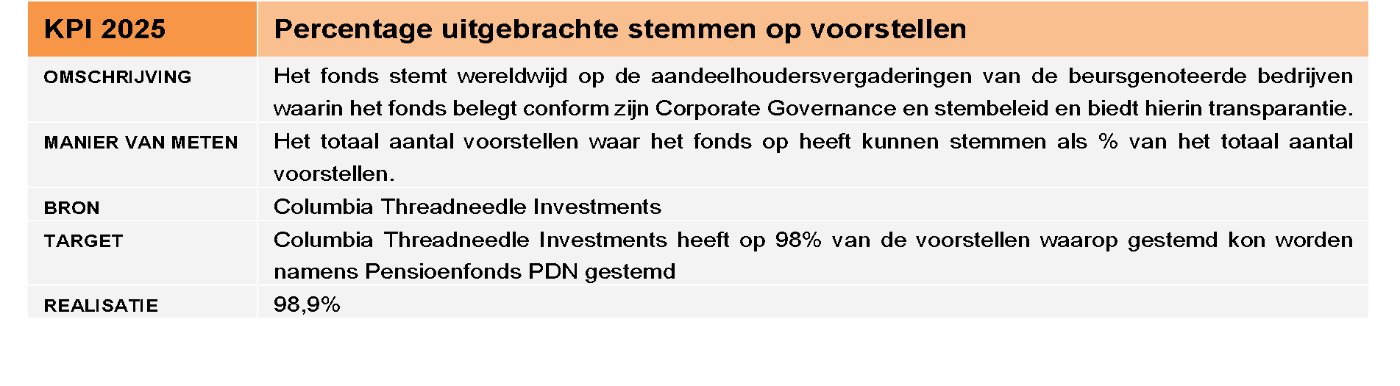
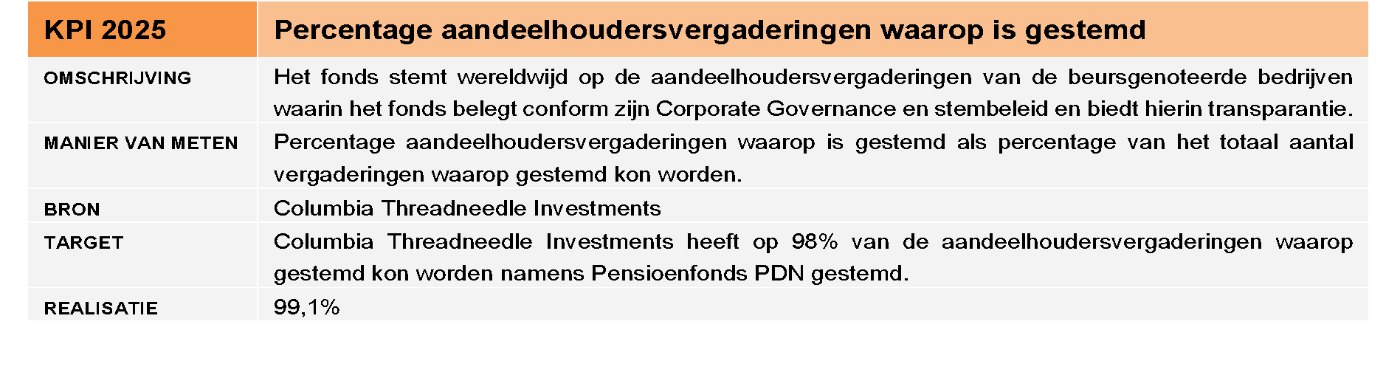
In 2025, 984 shareholder meetings took place for all listed companies in the Pensioenfonds PDN portfolio. At 975 of those meetings, CTI was able to vote on behalf of Pensioenfonds PDN. For 9 meetings, this was not possible due to applicable liquidity-restricting conditions or other operational restrictions in the voting process.

At all 975 shareholder meetings, votes were cast on more than 12.000 proposals. As mentioned above, it was not possible to vote at a number of shareholder meetings, as a result of which a total of 1,1% of the proposals were not voted on. The remaining 98,9% were voted on.

Realization of Voting Policy objectives
media&token=9641d636-ef28-4a84-9de8-8773f93b5fc7

media&token=e90a9546-b62c-4c5f-b67e-c95204f07ed4

5. Exclusion

Pensioenfonds PDN invests in such a way that its investments are a reflection of its own norms and values. The fund therefore excludes companies and countries based on the risk of negative impact and conflict with its norms and values. Pensioenfonds PDN applies criteria here such as the harmfulness of the product, the ability to bring about change through voting and engagement, and the fact that there would be adverse consequences if the product were to no longer exist.

Product groups that we (partially) exclude, for example, are controversial weapons, cluster munitions, coal, oil from tar sands and tobacco. Companies or countries that we exclude based on their behavior are based on the 10 principles of the VN Global Compact and international sanction lists of the VN Veiligheidsraad, the Netherlands and-or the European Union. In the event of serious and structural violations, countries and companies are added to the exclusion list.

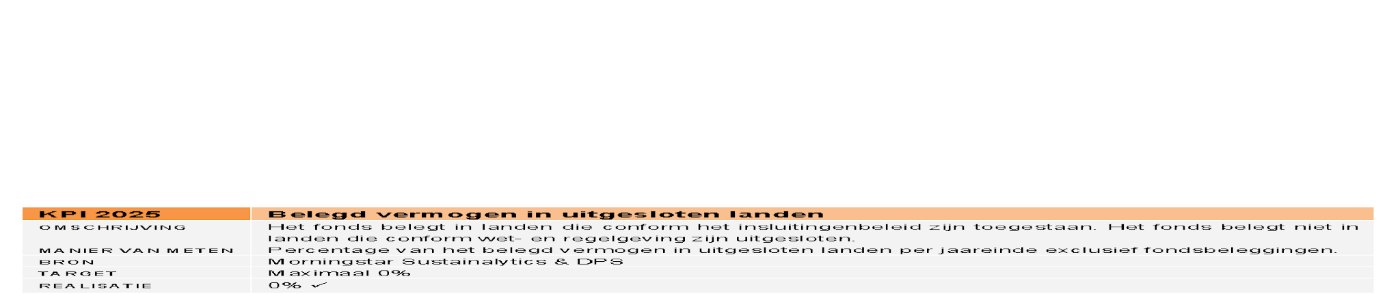
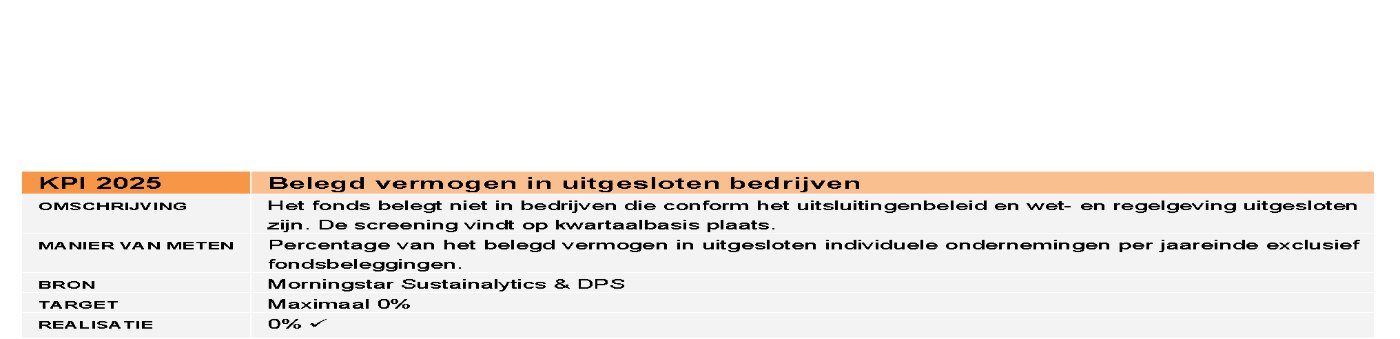
Our objective for exclusions means that we do not hold investments in companies and countries, excluding fund investments, that are on the exclusion list. We have achieved this. Within a quarter after screening, individual investments in companies and countries that were on the exclusion list were sold. At the end of 2025, Pensioenfonds PDN excludes a total of 164 companies and 15 countries from the investment universe. This is 3 companies fewer and the same number of countries compared to the end of 2024.


Realization of Exclusion objectives
media&token=3c69481c-2b1c-469a-b0c1-f5f83e09611c

media&token=fce5bae1-30ce-4828-8da1-3ab0e72a08b2

6. Transparency

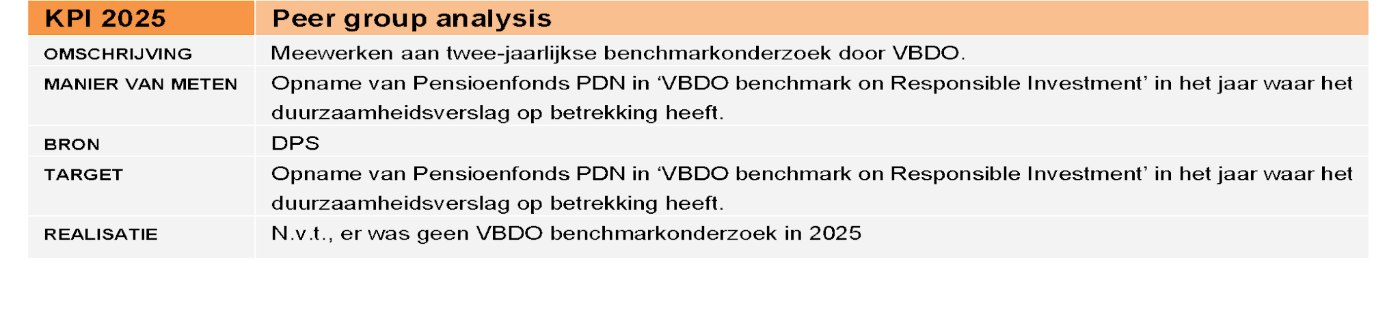
To be transparent about the sustainability policy and its implementation, the fund publishes an annual sustainability report. In addition, Pensioenfonds PDN publishes an overview of the total investment portfolio on its website on an annual basis, and we report on the website about the outcomes of voting behavior at shareholder meetings. Finally, the fund participates in market-wide initiatives such as the VBDO benchmark and the UN PRI assessment.


media&token=f62aa2df-d772-4128-8f20-74d4bf7669d0

media&token=00dd1988-93fc-4a7f-9305-4065f0fc2429

media&token=a10763ed-b43c-4ed6-ac9e-49b98039545e

media&token=b769f1bd-4150-4ae4-86fa-2102e4bdf6d2

Implementation of sustainability legislation and covenants in 2025

Mandatory laws and regulations in the field of sustainability have been increasingly expanded in recent years as a result of the European Action Plan 'Financing Sustainable Growth'. The goal of this action plan is to stimulate the financial sector to contribute to the Paris climate goals.

EU Sustainability Finance Disclosure Regulation (SFDR legislation)

In the context of the SFDR legislation, Pensioenfonds PDN has opted for an 'Article 8 classification'. This means that the fund implements sustainability characteristics within its investment portfolio and also reports transparently on this. In 2025, the fund reported in the context of the SFDR legislation on the main impacts on sustainability factors prescribed by the SFDR legislation. Pensioenfonds PDN does not yet set a target percentage of sustainable investments within the meaning of SFDR, but it certainly does invest in sustainable investments. However, the difference in definitions of sustainable investments is still complex. Pensioenfonds PDN will continue in 2026 to assess whether applying a minimum percentage of sustainable investments within the meaning of the SFDR legislation is desirable and implementable (see also the Taxonomy section below).

Taxonomy

With the Taxonomy Regulation, the European Union has established criteria to determine per economic activity whether it is carried out sustainably. These are economic activities that contribute to an environmental objective and do not cause significant harm to other environmental objectives. In total, 6 different environmental objectives have been defined. Pensioenfonds PDN considers it important that it also invests in economic activities that contribute to these environmental objectives. To determine how much Pensioenfonds PDN invests in this, it must first become clear to what extent the companies contribute to these environmental objectives. To be able to determine this, a lot of data from these companies is required. Every year in the fourth quarter, Pensioenfonds PDN evaluates the data of companies in the portfolio and assesses what target percentage of Taxonomy-aligned investments Pensioenfonds PDN can set for the following year.

Outlook 2026

After a year of continuous efforts and dedication to sustainability policy, the focus in 2026 will remain on strengthening the sustainability ambition and implementing concrete measures that contribute to a better future for both participants and society as a whole.

In the coming year, we will continue to focus on the further development and implementation of the sustainability policy. Some important items that are high on the agenda include:

  • Sustainability framework : We will continue to strengthen the sustainability framework. In doing so, we will pay special attention to relevant themes and how we can further strengthen processes surrounding sustainable investing.

  • Sustainability report: The preparation of the sustainability report remains an important focus point. We strive to report transparently on sustainability performance and progress against objectives.

  • Target allocation impact bonds: We will evaluate the commitment to impact bonds and make adjustments where necessary to strengthen objectives in this area.

  • Target allocation EU taxonomy-related investments: Identifying and allocating investments that comply with the EU taxonomy will be a focus area to achieve sustainability objectives.

  • ESG Risk management: We will continue our efforts to effectively identify, assess, and manage ESG risks within the investment portfolio. In 2026, we will pay extra attention to further refining the ESG risk framework.

With these objectives in mind, we strive to further strengthen our role as a responsible investor and contribute to a more sustainable future for everyone.


Outlook

Outlook for 2026

FUTURE PENSIONS ACT

In 2026, Pensioenfonds PDN will continue to focus on the implementation of the Future Pensions Act (Wtp). On the hand, it will be a matter of waiting for DNB's response to the submitted transition notification. This could potentially lead to additional work for the fund. On the other hand, the fund, together with DPS, will shape the actual implementation in the systems and processes so that the transition to the new solidarity premium scheme can be made in a controlled manner and with integrity.

COLLECTIVE VALUE TRANSFER NPR

Pensioenfonds PDN received a request from all affiliated employers for a value transfer of the accrued capitals, entitlements and benefits in the net pension scheme (NPR) to an external party where the NPR will be accommodated. This must take place before the fund can transition to the Wtp. This will be further detailed in the first half of 2026.

COMMUNICATION

In 2026, communication about the transition to the new pension scheme will take center stage. To this end, the Wtp communication campaign plan has been drawn up.

Key priorities in this plan are:

  • Working on the trust of (former) participants and pensioners in both Pensioenfonds PDN and the new pension agreements based on the Wtp;
  • Transferring information relevant to the various target groups about the new pension;
  • Offering a perspective for action during the transition period in situations where participants can make choices that have a different effect on their pension before or after the transition date.

The implementation of this plan relates to the period after the transition plan has been presented to Pensioenfonds PDN and will continue until six months after the transition date.

SUSTAINABLE INVESTING

In 2026, we will evaluate our commitment to impact investing and make adjustments where necessary to strengthen our objectives in this area. The board will continue to deepen the sustainability framework, paying special attention to relevant themes and how we can further refine the processes surrounding sustainable investing.

STRATEGY

Pensioenfonds PDN will continue in 2026 with the vision and strategy for the fund for the future. The developments in the market for pensions in the Netherlands and in the pension sector in particular are assessed by Pensioenfonds PDN. Partly based on this, Pensioenfonds PDN will determine what role and position the fund can have after the transition to the new Pension Scheme. High-quality service provision to participants and affiliated parties and a good and sustainable pension remain the starting point. But innovation in technology and product development is moving fast. It is important for Pensioenfonds PDN to respond to this in a timely manner, in close cooperation with DPS, and thus remain relevant in its service provision.

IN CONCLUSION

In this section, the fund must pay attention to investments, financing, staffing and the circumstances on which turnover and profitability depend. For the fund, these have a different interpretation than for a commercial enterprise. The fund is a non-profit foundation, has no employees of its own and has outsourced the administration. For the future, we therefore expect that the number of employees will remain zero. There is no external financing, and the expectation is that this will not change in the future either. Investments concern the investment of the fund assets for the benefit of the pension obligations within the established investment and risk framework, we will continue to assess future investments against the investment and risk framework. The financial situation of the fund is therefore primarily dependent on interest rate, inflation and market conditions, demographic developments and (changes in) laws and regulations, and not on revenue growth or commercial profitability.