Pension Fund PDN explains its sustainability policy and accounts for the main results for the reporting year 2025 in the Sustainability Report 2025. The full sustainability report can be found on the website of Pension Fund PDN under downloads.
In light of the pursuit of sustainability and responsible investment, the fund further tightened its sustainability policy in 2025. To be able to assess and manage the most material sustainability risks, Pensioenfonds PDN further developed the ESG risk framework in 2025 and set up an ESG risk dashboard. In 2026, it will be assessed whether additional relevant risk factors must be included. The fund also further refined the escalation policy regarding the progress of engagement trajectories and acted upon this in 2025. The focus has shifted from responsiveness to actual progress made. In addition, Pensioenfonds PDN evaluated the sustainability indicators and concluded that the KPI on achieving engagement‑milestones was steerable and therefore did not make the desired impact. This KPI was therefore scrapped, while the SDG‑oriented KPI is retained. Pensioenfonds PDN will continue to evaluate the KPIs and tighten them where necessary.
The fund reports transparently on the implementation and effects of the sustainability policy in this sustainability report, which is also published on the fund's website. However, as of 2025, the figures are no longer externally audited for cost reasons.
With a view to a sustainable future, we will continue our efforts in 2026, and we remain committed to promoting sustainability in every layer of investment policy.
Future perspectives
Looking ahead, we see several important themes that deserve attention:
Digital transformation and sustainability: The role of technology in promoting sustainability is significant. Innovations can contribute to energy efficiency and the development of smart, sustainable cities.
Social inclusion and employment: By investing in sustainable projects, we can contribute to job creation and the promotion of social inclusion.
Circular economy: Supporting companies that embrace the principles of the circular economy is a step towards minimizing waste and using resources efficiently, including water management.
Ethical investing and human rights: It is our responsibility to ensure that investments embrace ethical considerations and respect for human rights.
Biodiversity: Protecting and promoting biodiversity is essential for the preservation of healthy ecosystems, which are crucial for life on earth. More and more attention is being paid within the investment world to investments that contribute to the protection of natural habitats and the diversity of species.
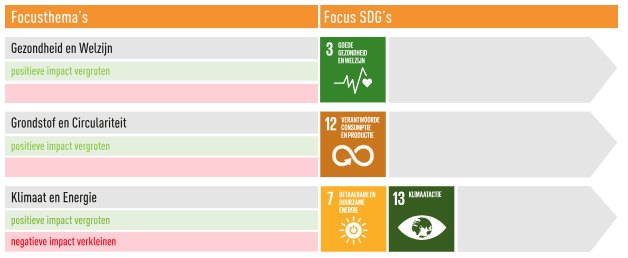
We see the complexity of the challenges we face and at the same time we see the opportunities to make a positive impact. With dedication, innovation, and collaboration, we can contribute to a more sustainable and fairer world for everyone. To increase our positive influence as a fund, we have been focusing on three specific sustainability themes since 2021:
Health and well-being
Climate and energy
Raw materials and circularity.
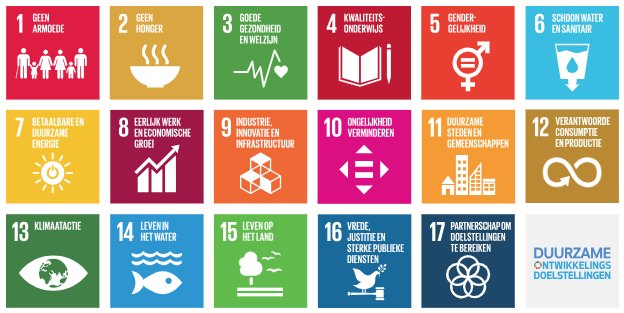
These themes are linked to four sustainable goals of the United Nations, the Sustainable Development Goals (SDGs). We specifically look at:
SDG 3: Good health and well-being
SDG 7: Affordable and sustainable energy
SDG 12: Responsible consumption and production
SDG 13: Climate action
Six policy instruments have been defined in the sustainability policy, which are used to contribute to objectives.
More information about the sustainability policy and the policy instruments that Pensioenfonds PDN uses within it can be found on the fund's website via this link. On this page, an explanation of the policy pursued can also be found, including reports on how votes were cast during shareholder meetings and the progress of engagement actions. The fund also publishes the list of companies and countries in which it has invested (as of year-end) on the website.
1. ESG integration
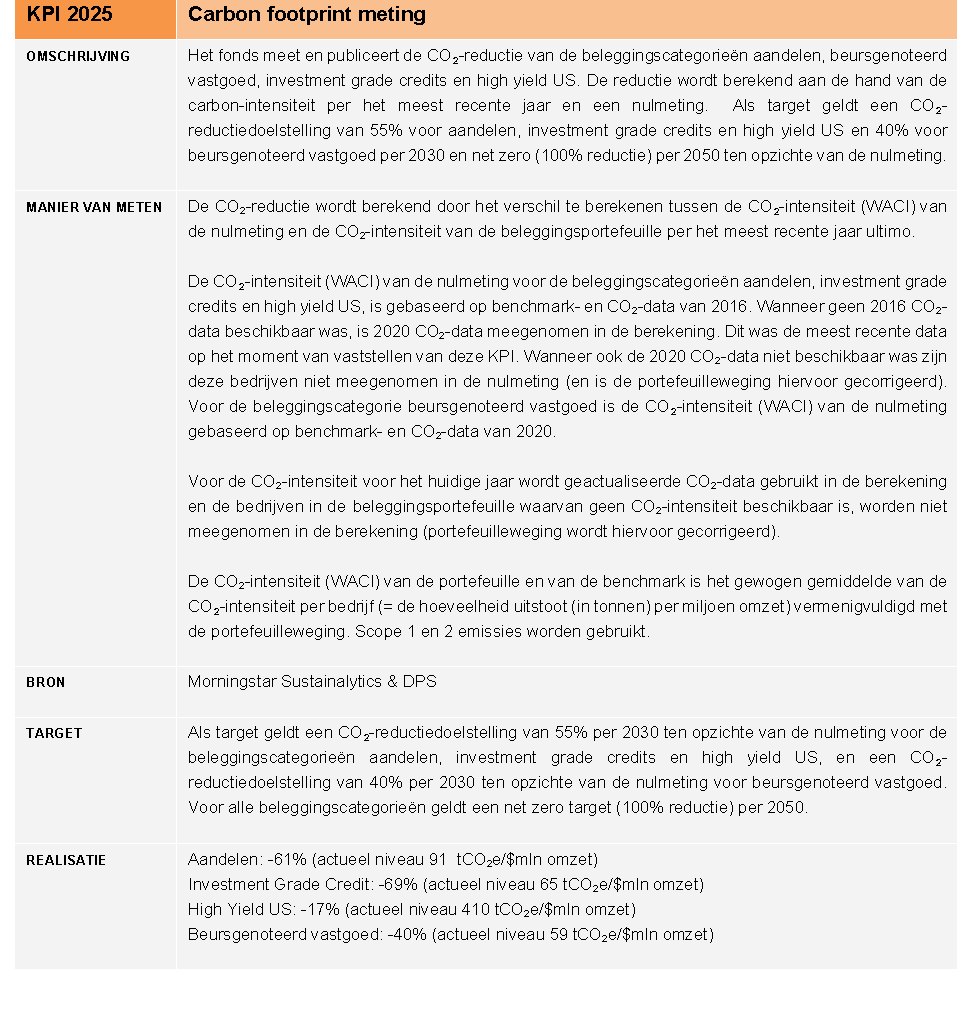
Pensioenfonds PDN utilizes ESG factors wherever possible in the management and assessment of investments. ESG stands for Environment (environment), Social (social), and Governance (corporate governance). Sustainability risks for the portfolio and other ESG aspects are taken into account in investment decisions in the various mandates. Another striking aspect that falls under this is CO2 emissions. With ESG integration in the investment process, Pensioenfonds PDN tries to reduce the CO2 emissions of the investment portfolio. Whether or not this objective is actually achieved can only be determined after 2030. However, we can monitor the progress of the CO2 reduction in the meantime.
Realization of CO2 reduction objective
2. Impact Investments
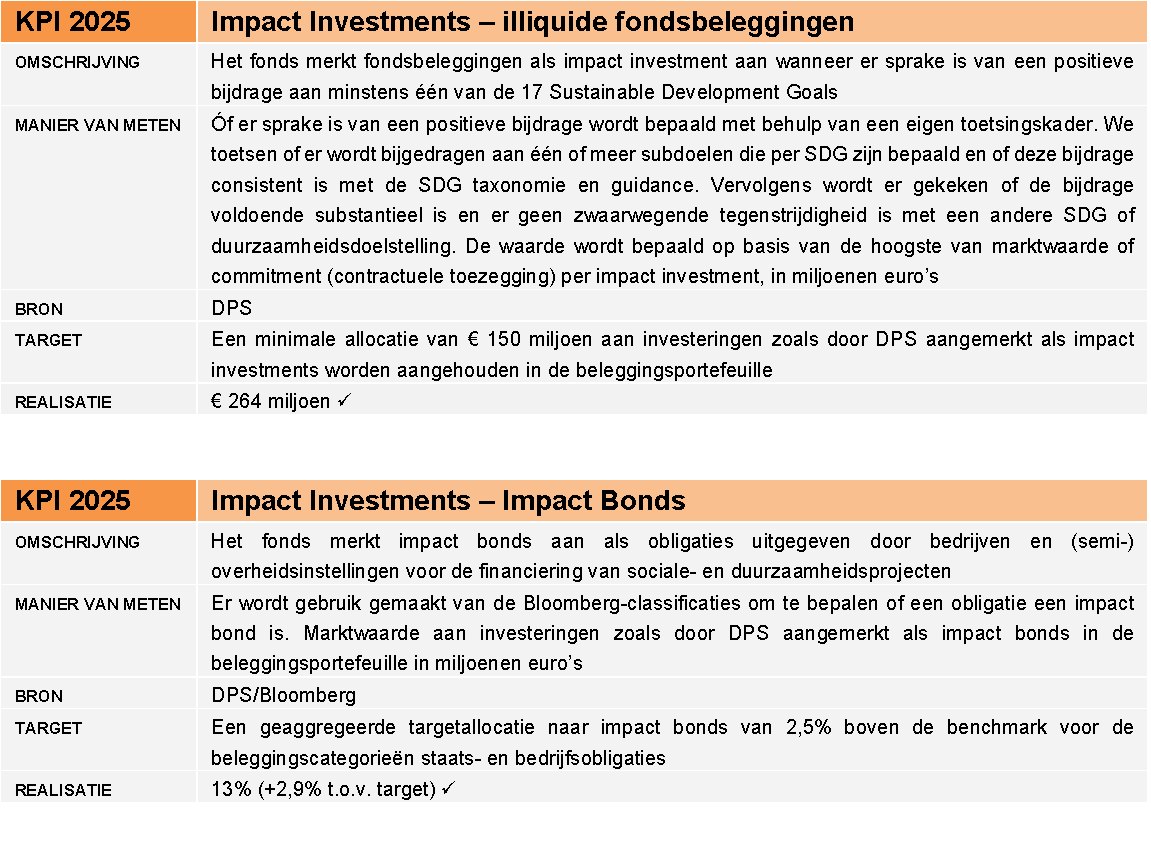
Impact investments are investments in countries, companies, or projects that also help solve social and environmental problems, such as poverty and climate change. Pensioenfonds PDN does this based on the Sustainable Development Goals of the United Nations.
Realization of Impact Investments objective
 3. Engagement
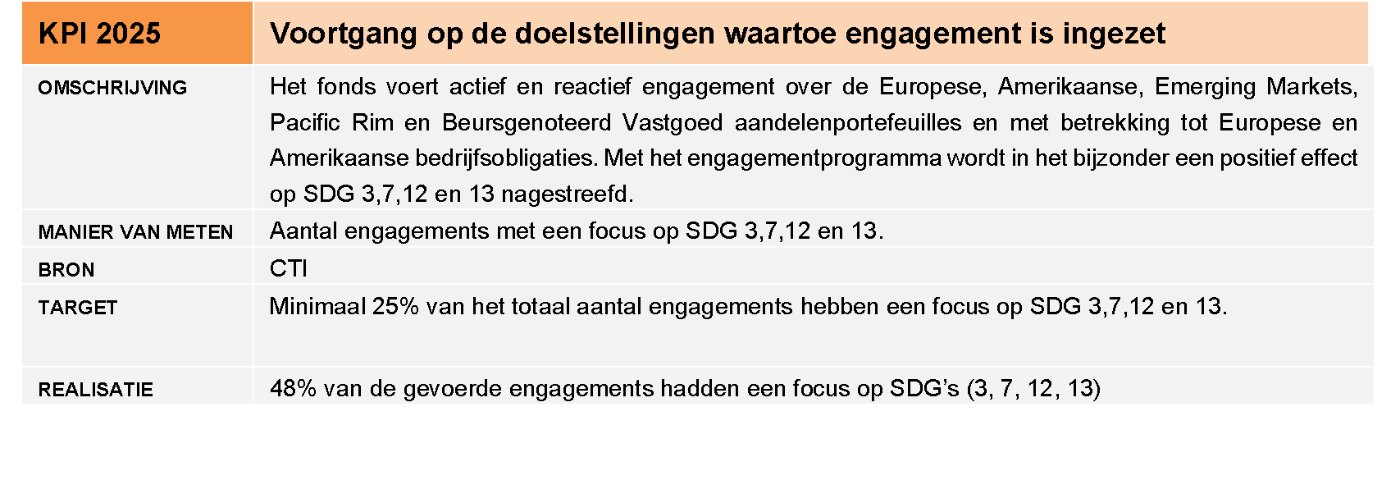
With engagement, a dialogue is entered into with companies in which investments are made. In this way, stakeholders can encourage companies to change. Through the instrument of engagement, it is possible to make agreements with companies about plans, goals, or ambitions. For example, with regard to a CO2 reduction. Also, with the help of engagement, a trajectory of intensive dialogue is started with companies that exhibit behavior that is not in line with the principles of the UN Global Compact and where (potential) negative impact has been identified. An engagement trajectory can be labeled as a proactive or reactive engagement trajectory.
Engagement process
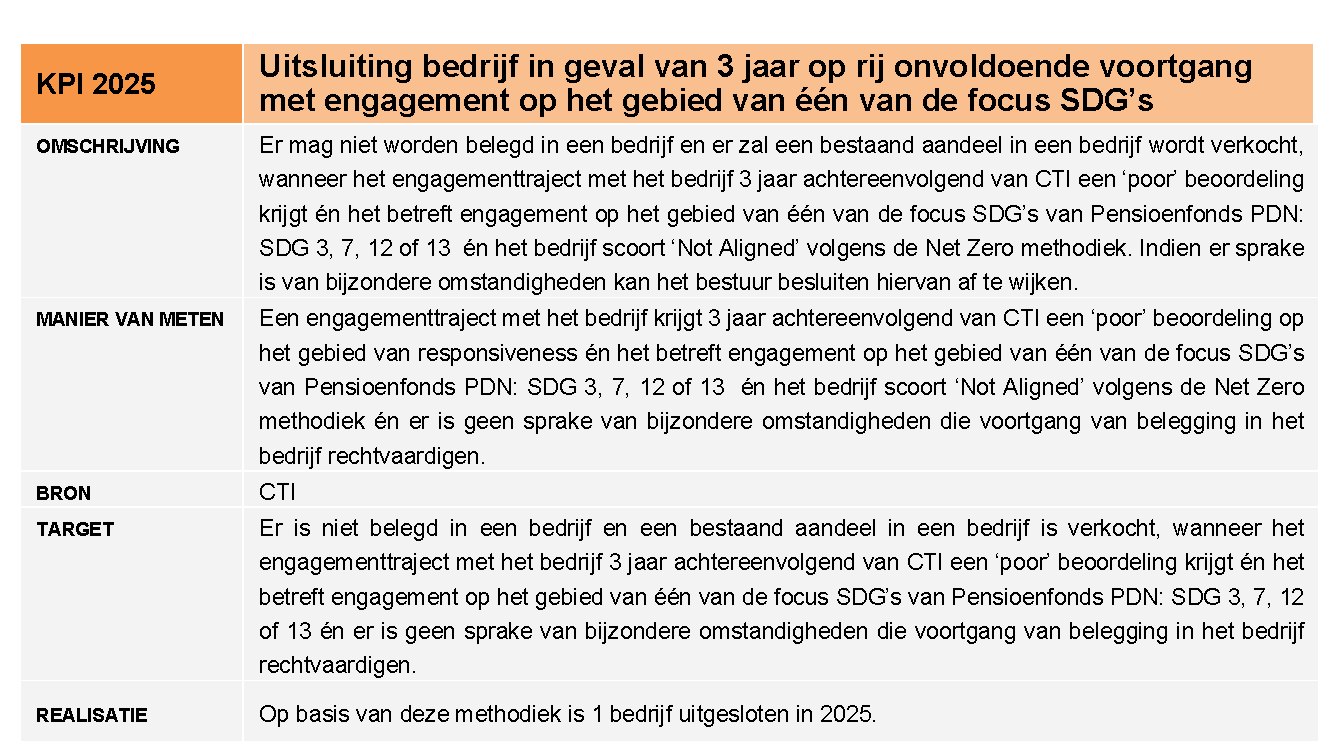
An engagement trajectory consists of four phases. It starts with setting a company-specific objective. Then CTI contacts the relevant company to raise the identified problems. After this, it is monitored to what extent the company makes commitments to tackle the problem until the moment the problems are solved and the objective has been achieved. Unfortunately, the latter is not always the final destination of an engagement trajectory. Companies may 'not respond' somewhere during these phases, as a result of which an engagement trajectory must be aborted. If the engagement trajectory does not lead to the desired result, the escalation ladder indicates under which conditions divestment will take place.
Realization of Engagement objective
4. Voting policy
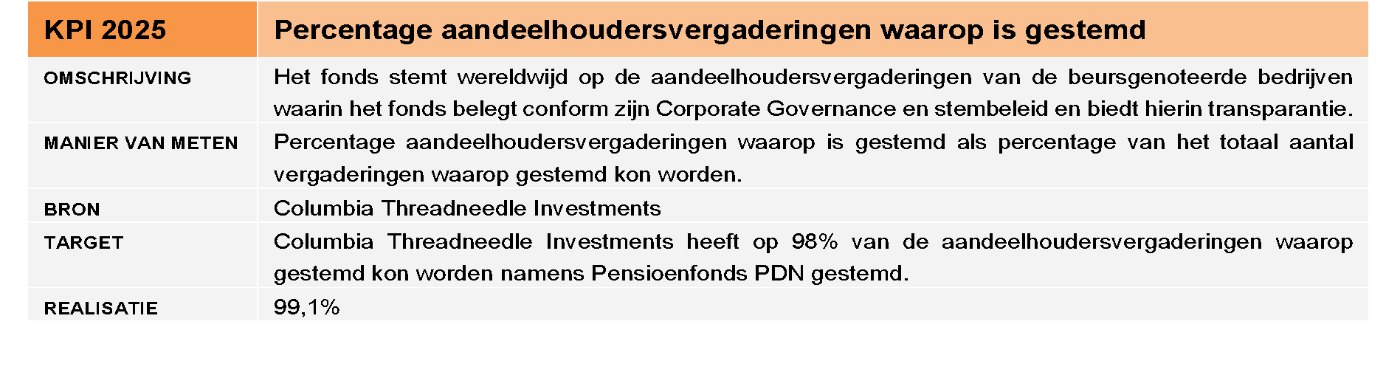
As an institutional investor, Pensioenfonds PDN complies with the Dutch Corporate Governance Code. This code contains principles and provisions on good corporate governance. Pensioenfonds PDN's policy for good governance is aimed at protecting interests as a shareholder and giving substance to responsibility as a shareholder. When there are indications regarding a company, there are various ways in which Pensioenfonds PDN can exert its influence, including voting at the shareholder meetings of all listed companies in which the fund invests worldwide. On the website, we publish every quarter how votes were cast at the general meeting of those in which we invest. We do this per individual and per voting item.
In 2025, 984 shareholder meetings took place for all listed companies in the Pensioenfonds PDN portfolio. At 975 of those meetings, CTI was able to vote on behalf of Pensioenfonds PDN. For 9 meetings, this was not possible due to applicable liquidity-restricting conditions or other operational restrictions in the voting process.
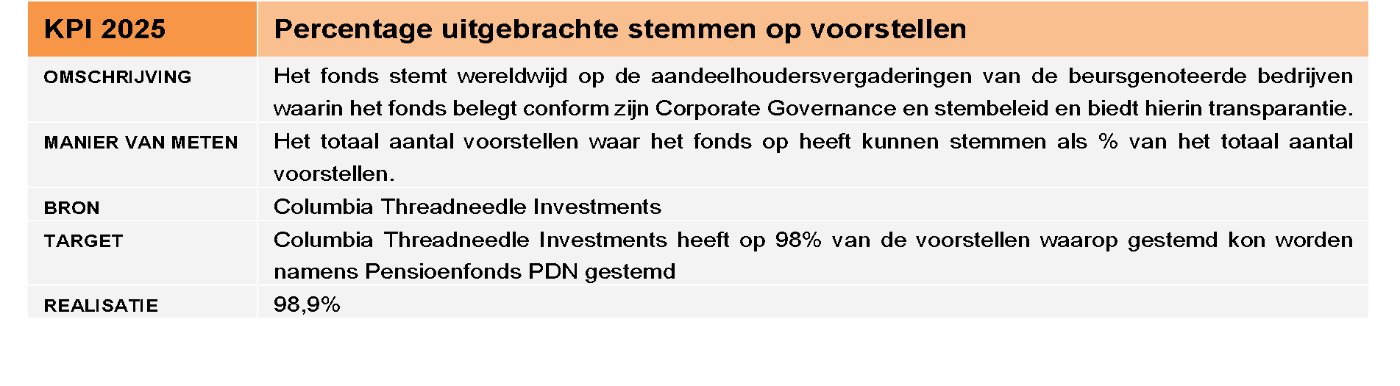
At all 975 shareholder meetings, votes were cast on more than 12.000 proposals. As mentioned above, it was not possible to vote at a number of shareholder meetings, as a result of which a total of 1,1% of the proposals were not voted on. The remaining 98,9% were voted on.
Realization of Voting Policy objectives
5. Exclusion
Pensioenfonds PDN invests in such a way that its investments are a reflection of its own norms and values. The fund therefore excludes companies and countries based on the risk of negative impact and conflict with its norms and values. Pensioenfonds PDN applies criteria here such as the harmfulness of the product, the ability to bring about change through voting and engagement, and the fact that there would be adverse consequences if the product were to no longer exist.
Product groups that we (partially) exclude, for example, are controversial weapons, cluster munitions, coal, oil from tar sands and tobacco. Companies or countries that we exclude based on their behavior are based on the 10 principles of the VN Global Compact and international sanction lists of the VN Veiligheidsraad, the Netherlands and-or the European Union. In the event of serious and structural violations, countries and companies are added to the exclusion list.
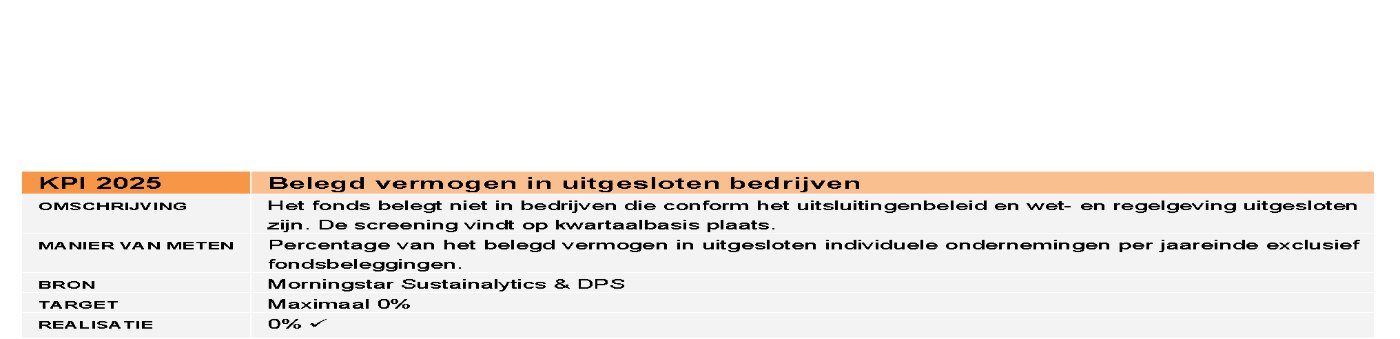
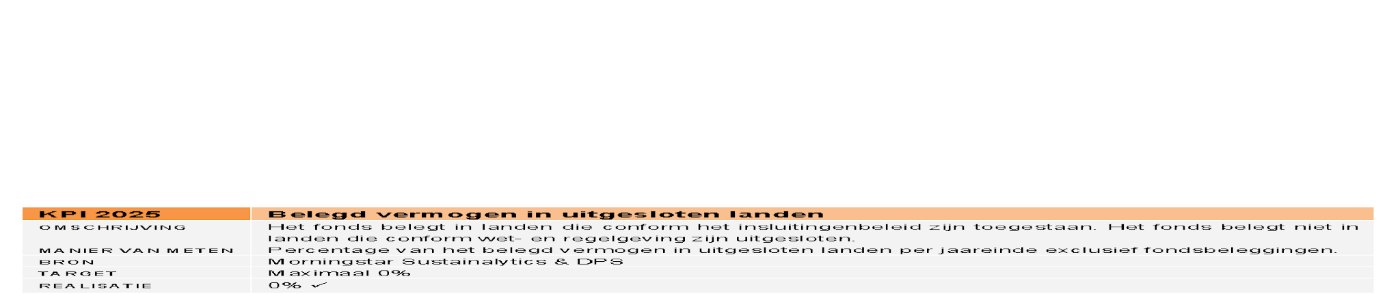
Our objective for exclusions means that we do not hold investments in companies and countries, excluding fund investments, that are on the exclusion list. We have achieved this. Within a quarter after screening, individual investments in companies and countries that were on the exclusion list were sold. At the end of 2025, Pensioenfonds PDN excludes a total of 164 companies and 15 countries from the investment universe. This is 3 companies fewer and the same number of countries compared to the end of 2024.
Realization of Exclusion objectives
6. Transparency
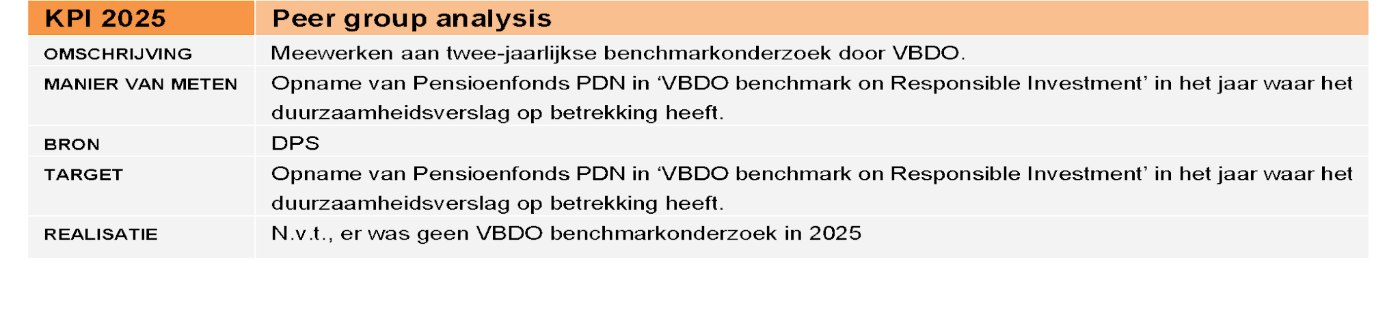
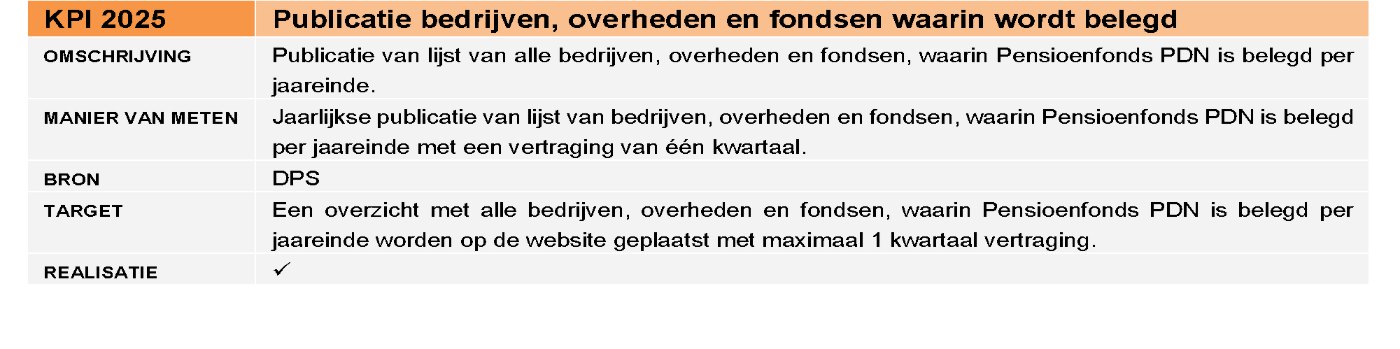
To be transparent about the sustainability policy and its implementation, the fund publishes an annual sustainability report. In addition, Pensioenfonds PDN publishes an overview of the total investment portfolio on its website on an annual basis, and we report on the website about the outcomes of voting behavior at shareholder meetings. Finally, the fund participates in market-wide initiatives such as the VBDO benchmark and the UN PRI assessment.


Implementation of sustainability legislation and covenants in 2025
Mandatory laws and regulations in the field of sustainability have been increasingly expanded in recent years as a result of the European Action Plan 'Financing Sustainable Growth'. The goal of this action plan is to stimulate the financial sector to contribute to the Paris climate goals.
EU Sustainability Finance Disclosure Regulation (SFDR legislation)
In the context of the SFDR legislation, Pensioenfonds PDN has opted for an 'Article 8 classification'. This means that the fund implements sustainability characteristics within its investment portfolio and also reports transparently on this. In 2025, the fund reported in the context of the SFDR legislation on the main impacts on sustainability factors prescribed by the SFDR legislation. Pensioenfonds PDN does not yet set a target percentage of sustainable investments within the meaning of SFDR, but it certainly does invest in sustainable investments. However, the difference in definitions of sustainable investments is still complex. Pensioenfonds PDN will continue in 2026 to assess whether applying a minimum percentage of sustainable investments within the meaning of the SFDR legislation is desirable and implementable (see also the Taxonomy section below).
Taxonomy
With the Taxonomy Regulation, the European Union has established criteria to determine per economic activity whether it is carried out sustainably. These are economic activities that contribute to an environmental objective and do not cause significant harm to other environmental objectives. In total, 6 different environmental objectives have been defined. Pensioenfonds PDN considers it important that it also invests in economic activities that contribute to these environmental objectives. To determine how much Pensioenfonds PDN invests in this, it must first become clear to what extent the companies contribute to these environmental objectives. To be able to determine this, a lot of data from these companies is required. Every year in the fourth quarter, Pensioenfonds PDN evaluates the data of companies in the portfolio and assesses what target percentage of Taxonomy-aligned investments Pensioenfonds PDN can set for the following year.
Outlook 2026
After a year of continuous efforts and dedication to sustainability policy, the focus in 2026 will remain on strengthening the sustainability ambition and implementing concrete measures that contribute to a better future for both participants and society as a whole.
In the coming year, we will continue to focus on the further development and implementation of the sustainability policy. Some important items that are high on the agenda include:
Sustainability framework : We will continue to strengthen the sustainability framework. In doing so, we will pay special attention to relevant themes and how we can further strengthen processes surrounding sustainable investing.
Sustainability report: The preparation of the sustainability report remains an important focus point. We strive to report transparently on sustainability performance and progress against objectives.
Target allocation impact bonds: We will evaluate the commitment to impact bonds and make adjustments where necessary to strengthen objectives in this area.
Target allocation EU taxonomy-related investments: Identifying and allocating investments that comply with the EU taxonomy will be a focus area to achieve sustainability objectives.
ESG Risk management: We will continue our efforts to effectively identify, assess, and manage ESG risks within the investment portfolio. In 2026, we will pay extra attention to further refining the ESG risk framework.
With these objectives in mind, we strive to further strengthen our role as a responsible investor and contribute to a more sustainable future for everyone.